Showing posts with label Charles Bukowski. Show all posts

Saturday, January 11, 2025

Guided by colours: Robert Roman speaks about Pascal Ulrich

Robert Roman (R) and Pascal Ulrich, Toulouse 2000

Artist and poet Pascal Ulrich was born in Strasbourg in 1964. He started writing poetry at the age of 16 and at 23 he created a small poetry magazine called Dada 64. When he was 25, after a suicide attempt and time spent in a psychiatric hospital, he was given a disability pension and was thereafter able to devote himself to writing and art. Having battled with depression and alcohol problems throughout his life, Ulrich committed suicide in 2009.

Robert Roman is a poet and artist who befriend Ulrich in 1994. After Ulrich’s death he published a biography of him, Pascal Ulrich –  The Lucid Dreamer,  plus several collections of Ulrich’s poems and drawings. In 2014 he formed  the BAKOU 98 association to preserve Ulrich’s work. He  also created a blog devoted to Ulrich’s poetry, art and life.

Painting 2005

When and how did you meet Pascal Ulrich? Had you been aware of his art or poetry before you met him?

Pascal Ulrich wrote me a first letter on June 16, 1994. I received it two days later, directly at my workplace. The letter came with a collage. In his letter, Pascal explained to me that he was contacting me following a request from Patrick Oustric, with whom he had been corresponding for several years. And it turns out that this Patrick Oustric, poet, and great lover of ancient letters, was one of my work colleagues! At that time I had not heard of Pascal Ulrich. I responded very quickly and that’s how our friendship began. We corresponded for fifteen years at the rate of at least one letter per week and we met eight times in Toulouse and once in Strasbourg.

Pascal’s art consisted of ink drawings, mail art, acrylic paintings, murals, and objects. Which did he prefer? I have seen only one or two collages of his – did collage not interest him?

His art has been guided above all by constant evolution and inspiration throughout his experiences and discoveries in his life as a man and as an artist. At first, it was just felt-tip pen drawings on simple sheets of paper or gouache paintings on Canson paper. Then in 1996, he started decorating his envelopes. His first attempts were clumsy because Pascal did not know how to draw. From 1997 his drawings with coloured markers became more beautiful and that is when he found his own style : shapes that snake around multiple heads. This is how his Postal Art began, which he then spread throughout the world.

Markers 2004

Pascal was interested in collage, but to my knowledge he practiced this art very little.

During the summer of 1998, with the multicultural workshop in the port of Kehl, on the French/German border, with a German metal sculptor, he discovered acrylic painting and, on this occasion, took the pseudonym Bakou.

But ultimately it was the technique of coloured felt-tip pens with which he felt truly comfortable. It prevailed through all of his work because Pascal had an innate sense for playing with colours, whether on envelopes or on sheets of different formats.

Pascal’s work could be classified as Art Brut. Did his consider his work as such, or did he not like his work being categorised?

Makers and coloured pencils 2002

Yes, I think that we can describe Pascal’s work as Art Brut Art even if he himself never formulated it that way. Pascal rejected many things : society, family, traditions, having children, celebrating Christmas or birthdays and even the constraints of art galleries. He refused to obey certain rules and therefore he did not appreciate being able to put a label on his back.

His art is figurative – it is always figures – not scenes or landscapes or still life. In that way his work reminds me of Gaston Chaissac – was he influenced by Chaissac at all?

Like Chaissac, Pascal was an autodidact. He had found his style on his own, even if Chaissac had been influenced by Picasso. I think that Pascal was not indifferent to the work of Chaissac, but he also loved Edvard Munch and Hans Arp, whose drawn shapes and colours can also be found in Pascal's drawings.

It seems Pascal did not give titles to his work – is that correct?

On several occasions Pascal gave a title to a drawing or painting, but he wrote the title directly on the work. He also sometimes did it on the envelopes he decorated. In general, though, it was more of a phrase or a sentence than a real title. But he rarely did this throughout his work.

Markers 2008

Pascal was also a very prolific poet. I believe Bukowski was a big influence. What other poets did he enjoy reading?

Pascal drew more than he wrote and perhaps his major fault as a poet was that he was satisfied with the first draft. In fact, Pascal rarely reworked his texts. He read a lot and Bukowski was in his library but he also appreciated Jules Mougin with whom he corresponded for some time, also Armand Olivennes, Jean-Jacques Lebel, Henri Michaux, Allen Ginsberg, Benjamin Péret, Baudelaire, etc.

Pascal was also a publisher, issuing small press books of his own work and others. I am interested in the small poetry journal he started in the late 1980s called Dada 64. Could you tell us something about his publications?

Indeed, in 1987, Pascal published Dada 64, a small poetry magazine, put together by himself and which ran for three issues. Inside, you can find his texts or drawings but also those of Marc Syren, Jacques Lucchesi, Gaston Criel, Marjan or Jacques Canut. Subsequently, with Dada 64 editions, he also published several poetry booklets.

Markers 2005

In 1991 he created Absurde Crépuscule and self-published three booklets.

In 1992, Pascal invented L’ours qui parle  (The Talking Bear), a simple sheet, single-sided, A4 format and photocopied, distributed by post and each time containing two or three poems of his own.

Markers 2006

In 1996 he reintroduced Absurde Crépuscule. This poetic entity was a publishing house until 1998, then a poetry magazine of the same name from 1997, which stopped after three issues.

Finally, at the beginning of 2008, he published Epitaphes, a series of 105 aphorisms and the final collection at Absurde Crépuscule.

Markers 2003

Pascal also loved music, ranging from classical to rock. He was a great lover of bands such as Soft Machine and musicians such as Nick Drake. In one of his final letters, to Bruno Sourdin, he chatted about Syd Barrett. Did he listen to music while he worked? Did he find it inspirational?

Pascal  was an insomniac. In the evening, while his partner slept, he listened to all kinds of music while writing letters or decorating envelopes. This could last most of the night, but he always got up quite early. Pascal had great sensitivity and the music he listened to for hours guided his hand on the paper.

Markers 2000

At one point Pascal was trying to create an arts centre, similar to Warhol’s Factory, but it collapsed. What happened? 

The multicultural workshop in the port of Kehl, in Germany, from July to December 1998, was a great artistic and human experience for Pascal, a great expectation but also a great disappointment. I never knew the end of the story but according to his letters of December 1998 and January 1999, his “associate”, the German metal sculptor, turned out to be a complete bastard. Pascal, being wholly uncompromising and libertarian, could not bear it and therefore immediately abandoned six months of work and hope.

Markers 2001

Pascal did manage to have a few exhibitions outside France – how did those come about?

Pascal exhibited in Cuba, Great Britain, Mexico, Germany, and Brazil, between 1996 and 1999. Apart from the Kehl exhibition in December 1998, where he was present, Pascal never visited the countries where he exhibited. In fact, I know very little about these exhibitions. Concerning the exhibition in Mexico in 1998, I think he was able to participate thanks to Ana, a Mexican violinist friend whom he had met in Strasbourg at the end of 1997 and who had to take some works with her in her suitcase. For the rest, I imagine that his epistolary relationships and the numerous contacts with foreign artists, authors and publishers made his participation in these exhibitions possible.

Pascal had an alcohol problem throughout his life. It started when he was a teenager and  towards the end of his short life he started drinking again, and could become violent when drunk. But how was he like when he was sober?

When I met Pascal for the first time in August 1997, he no longer drank a drop of alcohol following acute pancreatitis contracted in October of the previous year. We then saw each other eight times, and apart from his last visit in May 2008, which ended badly because he was drunk, I was lucky to only know him completely sober. So, most of the time I knew an intelligent, charming, calm, and generous man, curious about everything, mischievous and who had a lot of humour.

Mail art 2001
Since Pascal died, you have been trying to get art museums to take his work, but this has not been successful. Why are museums not interested in his work?

In 2014, I created the BAKOU 98 association whose goal is to make Pascal’s written and pictorial work known and continue. The association’s first action was to try to respect Pascal’s last wishes. Indeed, in his will, he wanted his drawings, paintings, and sculptures to be donated to the city of Strasbourg. Unfortunately, after months of procedures and discussions with the City Hall, they were  not willing to take the Ulrich archive. The reasons given by the cultural director were that it was impossible to follow up on our proposal given the orientations of the municipal collections and the numerous requests made to the city museums.

Mail art 2000

Following this first failure, the association contacted various museums presenting Art Brut. The first was La Collection de l’Art Brut de Lausanne in Switzerland, which very quickly declined our proposal, citing a restricted budget and a limitation of their reserve spaces, forcing them to be very selective regarding the acquisition of new pieces. Second failure.

Mail art 2001

Subsequently, La Halle Saint-Pierre in Paris informed me that it could not accept our donation because it did not have a collection (?). The Musée de la Création Franche in Bègles tells me that it will close its doors for work for at least four years. The Musée d’Art Brut de Montpellier told me that it is in demand from all sides and that due to lack of space it cannot consider the offers proposed to it. However, two years later, the museum accepted a donation of envelopes decorated by Pascal, which they would eventually present during a Postal Art exhibition. That’s it! Pascal Ulrich entered a museum through his Postal Art, but won't his envelopes stay at the bottom of a drawer ?

All the other museums contacted in France: La Fabuloserie in Dicy, the Musée Art et Déchirure in Rouen, the LAM near Lille, the Musée des Abattoirs in Toulouse and the MIAM in Sète, none of which responded to my emails and messages reminders.

Mail art 1999

You have published a few books of Pascal’s work posthumously. Could you tell us something about it, plus the biography of him that you published?

The first book that I published in my small poetry editions, five years after Pascal's death, was a 360-page colour book dedicated to the man, the poet, and the artist that he was. This biography was published in October 2014 and is entitled Pascal Ulrich – The Lucid Dreamer. We can follow his entire journey from his birth to his death and beyond. The book is embellished with numerous poems, letters, photos, drawings, and paintings, as well as testimonies from people who knew him.

Mail art 1997

Five other books were then published between 2015 and 2022. The first four were collections of poems and aphorisms written by Pascal in 1992, 1995, 1996, 2006 and 2007, in which  urgency, dazzlement, despair, revolt and death coexist, but also passion and love.

The latest collection contains only a series of black and white drawings executed with a felt-tip pen in 2004.


I am a frozen shadow

whose charm is in the fruit

of the melancholy twilight


*

Hello, what a pleasure

Goodbye, what a relief

Farewell, what a fatality


Pascal Ulrich, 1964―2009


Pascal Ulrich in Toulouse, 2005


This interview was first published in The Odd Magazine, in English and French.

Friday, July 14, 2017

Adrian Manning: A poetic microcosm

Adrian Manning is an English poet and micro-publisher. He has had a number of chapbooks published, including Wretched Songs For Out of Tune Musicians, Down At The Laundromat, Bring Down The Sun (with Henry Denander), These Days, Days Like This (with John Dorsey) and 13 Poems from the Edge of Extinction. His poems have been published around the world and have been nominated for the Pushcart Prize. He is the founder of Concrete Meat Press, a micro-press that publishes poetry broadsides and chapbooks.
He lives in Leicester, England.

DH: How and when did you start writing poetry? I am curious about the contemporary poetry scene in England. I regard most English poetry as conservative. Is there a strong ‘alternative’ poetry/literary culture there?

AM: I started writing when I was a teenager, about 17 or 18. I had a notebook in which I used to record my thoughts about my confused worldview at the time. It was sort of like a diary but the thoughts took on a poetic prose form. I became more serious about writing poems when I was studying for my degree and I borrowed a housemate’s electric typer. I have a collection of strange and probably not particularly good poems, but it was a start. I continued until my first poem was published in 1997 in a small magazine called Mudvein in the USA. Coincidentally, the poem was called "The First Poem" and that was really the start of what I would consider my serious writing. In those early days I submitted to magazines, this was before I had access to the internet, in the USA and New Zealand, purely because I was reading poets from outside the UK and corresponding with some poets from outside the UK as a fan. I bought the first two issues of Mudvein because one of them had a poem by Charles Bukowski in it. When I received it, I thought I'd give it a shot myself. Getting that acceptance was one of the major points in my writing career and always will be. The poem was published and Bukowski was in the same issue. I thought that was it! What more did I want? Of course, I continued writing and the goals got bigger.

I have always been interested mostly in American poetry ‒ certainly I was at that time. British poetry was not on my radar. As I have widened my reading over the years I can appreciate more British poetry but I'm still of the opinion that most writing that interests me is from outside of the UK. I don't really know about alternative poetry scenes in Britain. I have never been part of one. I know only a few English poets, amazingly. A lot of British poetry is conservative. There are some magazines around that are striking more of an alternative note, but I don't seem to have got involved with them ‒ so far!

There are poetry readings in England but I have limited experience of them. The first reading I ever went to was Allen Ginsberg in Wales! There are festivals, open-mic nights and so on as you would expect, but I notice that my fellow poets in the USA are more involved in group poetry readings of like-minded poets and visiting other cities. This is not something that I am aware of here. I have done a limited number of readings – my first was in London at a magazine launch. I then had a large gap between readings. My next was an event I organised called Beat and Beyond featuring Jim Burns, editor and poet Michael Curran from London and myself. We also showed films of various poets from outside the UK reading their poetry. This was held at a local venue – The Musician in Leicester, which I love and I have read there since. I'm still limited in the number of live readings I have done but I am hoping to do more soon. As for selling poetry at events– my experience is that you can sell a small number of books. That's just my experience – other poets may have different stories to tell. There is a small scene gathering just outside of Leicester in a town called Corby and I'm hoping to get involved in that sometime soon.

You have cited elsewhere poets such as William Wantling and Charles Bukowski as being influences. You have also spoken of your poetry as being ‘Meat Poetry’. What is that?

I had no real interest in poetry until I read Bukowski back in the 1980s. He wrote about the reality of his life and it was appealing to me. I started buying more Bukowski and completely fell for the man, the myth and the legend, whether it was ugly or beautiful. Reading Bukowski led me to other poets. I corresponded with A.D. Winans from that point on and Jim Burns, a British poet that I rate very highly, and they helped me to learn more about the poetry of the 1960s and 70s, including William Wantling. I started to investigate and collect works by these poets. Some of these are called Meat Poets and to me it meant that they wrote about the gritty and real issues of life without unnecessary flowery and overcomplicated language. I liked that and I hoped that my poems would be similar. I certainly started that way and still feel some of my poems reflect this. However, I am aware as time has passed different elements, including a more surrealistic style, have developed as well.

You are also a publisher, and run Concrete Meat Press. When and why did you decide to start up your own press?

I started Concrete Meat Press in 2004. I had a small collection of poems under the title Down At The Laundromat which I wanted to publish and give to some friends. So, I printed them myself on my computer and hand-painted washing machines on the covers in watercolours and sent them out under the Concrete Meat Press name. I only published ten numbered copies and then it was gone. I didn't really intend to publish much more until I did a joint broadside with David Barker and a chapbook called Too Much Me by David also. Since then I have published a few broadsides, some chapbooks of varying sizes and the Concrete Meat Sheet both in print and online.

Concrete Meat Press publishes chapbooks , micro-books and broadsides, with very small print runs. This is in the small press tradition. How receptive are English poets to such formats? In South Africa, poets generally want to be published in perfect-bound books. 

I publish in very small runs for a few reasons. Personally, I always like having one of a limited number of an item ‒it's the collector in me. Secondly, I'm not a businessman and selling poetry seems very difficult so I don't want to make hundreds and be left with them! I like to give away a lot of what I publish, so the less I have the quicker it goes! I've described Concrete Meat as a micro-press; smaller than the small press. Again, I mostly publish folks from outside the UK for the reasons explained before.  The English poets I have published have been happy with the small runs. I still get so much pleasure looking at a small chapbook from the 60s onwards as opposed to perfect-bound books. It does seem now that most poets are publishing their early works, even their first collection, in perfect-bound paperback form. I haven't had a collection of my own published in paperback yet! I take chapbooks seriously but others may not. I'm happy to swim against the tide on that one. 

I love print publications – you can't beat receiving and holding the work in your hands and taking it off the shelf. I have been published online and have published other poets online. The appeal of this is that it's more immediate and obviously has the potential to be much wider-reaching in its audience. But I still prefer print.

Do you find your role as poet and publisher compatible or do they sometimes conflict?

They are fairly compatible in that I enjoy reading new poems and publishing them ‒ it's pretty special to get poems from great poets that are not generally available. I also find seeing the poems an inspiration at times. Obviously, I also pursue my own writing too. I only publish what I like. I keep writing in my own way regardless of what I have published or plan to publish. I'm pretty slow at publishing, I have to admit, which is why I only do small runs of small books. I'm probably not the best role model as a publisher! That is another reason why I call Concrete Meat Press a micro-press. This is also why I end up giving a lot of publications away! I reiterate ‒ I'm a lousy businessman! My main focus is writing and getting my own poems into the world, so that takes priority overall.

You have published poems about the 1960s Cleveland poet d.a.levy, and also published poets who were associated with him – D.R. Wagner, Kent Taylor and Tom Kryss. Has levy – in his dual role as poet and publisher – had an influence on you?

Yes. There have been some very important poet influences on me. Bukowski and Burns I've mentioned. d.a. levy is another. I admire his stance ‒ write and publish poetry and give it away! I know he sold publications ‒ he had to eat ‒ but so much was handed out and sent in the mail to people. I admire the works he and his associates published ‒ how they look, feel ‒ the guts they had inside them. Kryss, rjs, Taylor and Wagner were so important in that regard.  I love his productivity (even though I cannot match it) When I started thinking of authors to publish in my Solid Flesh For Food series I wanted to have all these poets included. Kent Taylor is one of my favourite poets and everyone should read his poems, Wagner and Kryss are legends too. I contacted rjs but he doesn't write anymore and said he would rather give his slot to a newer poet. This whole Cleveland group has influenced me on so many ways.

You have published and/or are associated with poets who are also accomplished artists, such as D.R. Wagner, Tom Kryss and Henry Denander. And you are also an artist. Are you particularly attracted to the work of poets who are also artists – as was levy and others – including Bukowski.

I've always loved the artwork of Bukowski and really liked the idea of putting art into poetry books as Black Sparrow did with his first editions. When I published David Barker's Too Much Me I did 26 lettered copies with an original watercolour painting tipped in. levy's art is always interesting ‒ his methods, materials and variety are really fascinating. I like the silkscreen printed covers and Kryss was very involved in this. My link with Henry Denander came when Bill Roberts of Bottle of Smoke Press published my first book, Wretched Songs for Out of Tune Musicians, and he suggested Henry do the cover. I loved his idea, became good friends with him and began to collect his poetry and publications. He is an all-round great fellow. I've been honoured to publish a split chap with him, my photos adorned the cover, and he supplied the cover painting for my split chapbook with John Dorsey, These Days, Days Like This.

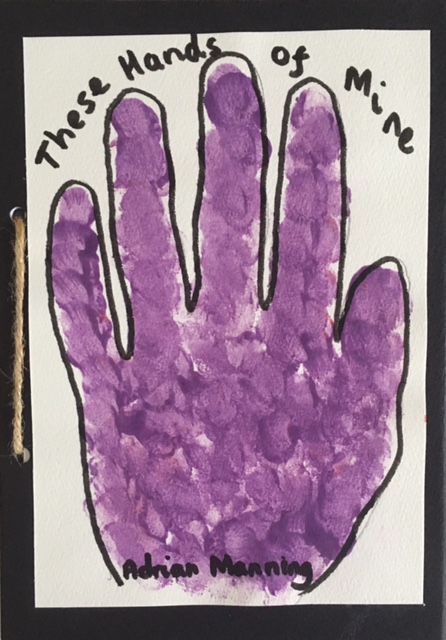
I am keen on adding something more to my chapbooks, so if I can I like to add some art. I painted the cover of Repeating The Mantra (Bottle of Smoke Press), the aforementioned first Concrete Meat Press book, provided the cover photo for my chapbook All This I See Before Me, All This I Cannot Resist (Alternating Current Press), have hand-painted covers to the reissue of These Hands of Mine (Concrete Meat Press) and I did hand-crayoned abstracts in each of the first 50 copies of These Days … so yes, I guess I have been very influenced by the poet/painters that I have come across! I like word and images mixed together at times. Levy, Kenneth Patchen, William Blake and others have done this well. I've been very fortunate to have the extremely talented Janne Karlsson illustrate several of my poems and my chapbook Wide Asleep, Fast Awake, which I am very proud of. It's something that works for me in the right conditions.

What is your opinion of the industries that have grown up around some of the US beat writers,  such as Kerouac, Burroughs and Ginsberg? There also seems to be an industry around Bukowski.

I like the fact that the interest around them ensures that we keep seeing new publications of their work or writing about them. What does make me sad is that the prices of the older books are so high that average collectors cannot afford them! For example, the Bukowski books with paintings!! These writers/poets became very well known and I admire and read them all so I guess where popularity leads to money there is always going to be those who seek to capitalise on it. I get saddened when I read of people other than the writers themselves making vast amounts of money out of their reputation and work. I'm not a capitalist, so anything like that does sadden me.

What projects do you have on the go?

I've recently published two short chapbooks   Dreams from Under a Rock through my press and 13 Poems from the Edge of Extinction, published by the wonderful John Burroughs at Crisis Chronicles Press. I have some poems coming up in publications and I am looking at a poetry reading coming up later in the year. I am also hoping to jump on stage with the incredible Mountaintop Junkshop ‒ I read a poem of mine in one of their songs ‒ soon.

I have been working on a joint chapbook with an American poet that I hope will be out before the year-end and I have some collections of poems that I would like to get out sometime. I am turning 50 late this year, so I would like to get a selected poems volume from the last 20 years together to mark the occasion ‒I may even go for a paperback publication! 

I will be completing publication of further Solid Flesh For Food chapbooks ‒ Neeli Cherkovski, Linda King, Catfish McDaris, Jake St John and the guitarist from an America alternative rock band who I can't name just yet ‒ if it comes together! There will be one more slot as I'll end on number 10 and that's undecided as yet.

I also contribute to a local Leicester culture magazine called Great Central ‒ I have a couple of interviews ‒ one with a local band and one with a legend, and some reviews I'm working on and whatever comes up with that ‒ so there's plenty going on!


Saturday, June 21, 2014

Catfish McDaris: An old-school outlaw

Catfish McDaris’s most infamous chapbook is Prying, with Jack Micheline and Charles Bukowski. His best readings were in Paris at the Shakespeare and Co. Bookstore and with Jimmy ‘the ghost of Hendrix’ Spencer in NYC on 42nd St. He’s done over 20 chaps in the last 25 years. He’s been published by New York Quarterly, Slipstream, Pearl, Main St. Rag, Café Review, Chiron Review, Zen Tattoo, Wormwood Review, Great Weather For Media, Silver Birch Press, and Graffiti Kolkata. He’s been nominated for 15 Pushcarts, the Best of Net in 2010 and 2013, he won the Uprising Award in 1999 and won the Flash Fiction Contest judged by the US Poet Laureate in 2009. He’s recently been translated into French, Polish, Swedish, Arabic, Bengali, Tagalog, and Esperanto. His 25 years of published material is in the Special Archives Collection at Marquette Univ. in Milwaukee, Wisconsin. He has also recently been published in New Coin, South Africa. His latest collection is Thieves of the Wind, with Kolkata poet and publisher Subhankar Das. 

DH: Perhaps an obvious first question revolves around your first name – Catfish. For me it conjures up images of the Mississippi, of delta blues and Mark Twain characters – so, how did you get the name Catfish? 

CM: Dave (Low Dog) Reeve, editor of Zen Tattoo took some of my poems, I told him I’d like to quit working for the Post Office in Milwaukee and start a catfish farm. He knew Bukowski slightly. This was about 94 and the name stuck. My sincere study of aquatic farming became just another unfulfilled dream. I started writing protest letters to newspapers, then I wrote a western novel (unpublished). I went to a poetry read and thought why not. I had lots of crazy fun reading and getting printed and meeting new people.

You have published quite a few titles, over 20, mainly chapbooks rather than full collections. I prefer chapbooks of poetry over thick volumes, there is a sense of intimacy or even of immediacy to a chapbook than a full collection doesn’t have. Did you go the chapbook route by choice?

I’m not exactly sure how many chapbooks I’ve done. I’ve always mixed poems with fiction, to me it’s all about storytelling. I have no academic credentials to get some big publishing house to print me. If Black Sparrow or City Lights would’ve come along and said let’s do it, I would have. On the other hand I’ve never self-published my own work. I figure if you can’t find a small press publisher, then your work must suck. I wouldn’t even venture a guess at how many small press publishers exist in US because they start and fold so quickly. There are university presses mostly from their English Dept. If you have no talent you won’t make it no matter where you live. With the web everything is international and in the blink of an eye.   

You had a chapbook published with Bukowski and Jack Micheline, called Prying. Bukowski is clearly an influence on your work – did you ever meet him? Did you ever meet Micheline?

I never met Bukowski, I’m sort of glad I didn’t. I consider him and Micheline geniuses, but I’ve seen films where Buk was mean to women and that behaviour pisses me off. I never met Jack either, except we became great pen-pals. I bought some of his paintings and chapbooks. He sent me poems of his and 4 unpublished poems from Buk from 74. Jack told me to write some nasty stories and find a publisher. That’s how Prying was born. Buk was dead by then and Mich died soon after.
                
I first encountered your name when you interviewed the poet Charles Plymell. Plymell is usually associated with the Beats but he doesn’t like being given that label and is quite critical of the Beats. There has been a bit of a Beat industry on the go – a Kerouac industry, a Burroughs industry, a Ginsberg industry. Would I be right in saying there is also a Bukowski industry? What are your feelings about these industries?

I met Plymell through being published together in the small press scene. The extensive interview I did with him was for the Chiron Review, it sort of opened my door to the Beatniks. Plymell stayed with us in Milwaukee in 96 on his way to meet Ginsberg and Burroughs. He introduced me to them through the mail and I got signed books from them. Two years later, in 98, I went to a 3-day Beatnik read in Cherry Valley, NY where Plymell lives and Ginsberg had a farm. I read with Ed Sanders, Anne Waldman, Ray Bremser, Janine Pommy Vega, Andy Clausen, David Amram, David Church, Claude Pelieu, Charles Plymell, Gordon Ball, and lots of other Beatniks and musicians such as Grant Hart. I think the Bukowski industry may overshadow all the Beatniks put together, but who really knows. The Beatniks and Bukowski are being overexposed. I prefer Buk over Kerouac any day. We need to create the next big move; we have the talent and technology. We don’t have to go on the road or live in a cardboard box, unless we feel like it. Caves are great; I spent almost three months in one. 

There is another label being used – outlaw poet. Do you consider yourself an outlaw poet? Do we need labels?

I don’t think we need labels, but I think we will never get around them. I have broken many laws in my 60 years. I’ve been in jail, never prison. If being an outlaw poet means you can write about things outside the law, then hell yea I’m an outlaw. I wasn’t in The Outlaw Bible of American Poetry unfortunately. That was fat anthology from 1999 put out by Thunder’s Mouth Press, dedicated to Jack Micheline. I was told to send work to it by Tommy Tucker from Bum Rush in NY in 98, I forgot. Alan Kaufman edited it with SA Griffin, it has all the outlaws except Bukowski. I have been to Billy the Kid’s grave, though. Since I grew up in Clovis, New Mexico, that wasn’t far from Billy the Kid country. He supposedly killed 21 men before he was 21. Billy is buried in Fort Sumner, New Mexico where they kept Geronimo prisoner. Watch Sam Peckinpah’s movie Pat Garrett and Billy the Kid. Bob Dylan is in it, he’s a knife-throwing expert and he does the soundtrack, notably Knockin’ on Heaven’s Door.   

Apart from poetry you also write flash fiction. When did you start writing flash fiction and why? Is flash fiction not in some ways a variation/extension of the prose poem?

It is all a story or a tale. Some mags want flash fiction some want poetry. It’s the same animal to me.

 What music do you like?

I like Hendrix, Prince, Satriani, Buddy Guy, Bonnie Raitt, Jeff Beck, Clapton, Santana. I listen to lots of Mexican and French music from my lady. The funny thing is I don’t hardly ever listen to music while I’m alone or writing.

You live in Milwaukee – that’s a city I have always associated with the TV sitcom Happy Days. What is the poetry and arts scene like in Milwaukee?

There are lots of breweries here. After the big Chicago fire, 1871, all the beer barons moved to Milwaukee because of Lake Michigan and fresh river water. We have a bronze Fonz statue, every few years the Happy Days folks come here. There are lots of good poets here. Antler and lots of academic poets, there are lots of reading venues. Also slams and rap contests. The art scene is super, lots of bohemians and a world-class art museum. Chicago is 90 minutes away and it is a great art and poetry city. In Milwaukee our art museum is right on Lake Michigan, It was designed by a Spaniard and opens its wings like the one in Sydney, Australia. I prefer paintings, but there are sculptures by Rodin. I like Bonnard, Caillebotte, Kandinsky, Klee, Miro, Monet, O’Keeffe, and Renoir - just to name a few in the permanent collection. Some of the local artists are great, there are many galleries and exhibits. I love Frida Kahlo, Van Gogh, Gauguin, Seurat, I also like Robert De Niro Sr.

What is the state of poetry publishing in the US as a whole? I should imagine that, like elsewhere in the world, sales are pretty bad. Here in South Africa fewer publishers are willing to take on poetry. Is it the same in the US? I see a lot of poets are now turning to self-publishing through print on demand initiatives such as Lulu.com.

Sales are terrible for poetry. People would rather buy a beer or tasteless hamburger than a chapbook. The market is so flooded (not just in the US, but worldwide) the old 'you buy mine, I’ll buy yours' is murder. I just mailed a chapbook to Quebec and it was almost $9.00 postage. I don’t understand print on demand, how can a publishing company give you a free ISBN (they usually cost $50) and print a perfect-bound or even hard-bound book and then put them for sale online and you just buy a few, or however many you feel like? I haven’t self-published any of my stuff, but friends with more computer knowledge than me have. This is crazy. I am old school, we used to send our work out with SASEs and wait by the mailbox with crossed fingers. Now you meet people all over the world in the blink of an eye. Maybe the Kindle will abolish printed books. I hope I don’t live to see that.

You started up a blog-based journal, ppigpenn, which contains mainly interviews and poetry. I think it is important that poets start up these initiatives, to create a creator awareness of what is happening in poetry, whether locally or internationally. What are your thoughts on this?

In some ways I think it’s cool to connect with so many people all over the world. On the other hand what makes me so special that I should be able to judge other writers’ work and decide if they are worthy to be published on ppigpenn. I try never to reject anyone, I may ask them to hit me with something harder, but I turn no one away. I’m lucky now that I have a partner watching my back, Michy McDannold from the Literary Underground.

You have just published a joint volume of poetry with Kolkata poet and publisher Subhankar Das, called Thieves of the Wind. A couple of years back you published another collaborative volume, with the Australian poet Ben John Smith, called Dancing Naked on Bukowski’s Grave. There was also the earlier collaborative volume with Bukowski and Micheline. Some publishers here in SA have done collective volumes of poetry – say, four or six poets in one volume – rather than single collections. What is the advantage of collaborative works, other than the sharing of resources? 
            
I consider Subhankar and Ben John top-notch writers from a totally different background and country. With the dismal sales in the small press world maybe having a brother along might help. Being printed with Bukowski and Micheline never hurt, but it sure never put a dime in my pocket. If you have to depend on writing for a living, I suggest go the Outlaw Poetry route. Rob a few banks now and then.

Tuesday, March 1, 2011

Yannis Livadas: The margins of a central man

Yannis Livadas was born in Kalamata, Greece in 1969. He has done dozens of different jobs and travelled extensively in India, Tunisia, Algeria, Italy, France, Morocco, Portugal and Spain. He has published seven poetry collections, the most recent being Ati: Scattered Poems 2001-2009. He has translated the work of authors such as Jack Kerouac, Gregory Corso and Charles Bukowski. He lives in Paris, France.  

DH: I'm curious about your background. When did you start writing seriously? 

YL: My background was the mess of the entity. Existence whirls and spirals unceasingly in its void; one must find ways to scan it on the wing. To lose self, to be a poet. I started writing poetry because I had a congenital tendency for writing, ink and paper. It was the only thing that was making me feel complete. I started writing seriously when I was sixteen or so, but I first published when I was thirty. It was really great to experience fortitude all this years. I had no reason to be in a hurry about it. 

You were once a bookseller and a publisher. What was that period like? 

 Ahh, that was a period full of mishaps and troubles. But I had to do that; I really liked the idea of making books, selling books, but those four years were more than enough. I faced too much bureaucracy in this country. So instead of being fulfilled publishing books I just suffered at the hands of officialdom. But it was also fun and I made new friends.

At first glance, your poetry looks surrealist, but your main influences seem to be pre-surrealist authors such as Apollinaire, but particularly Blaise Cendrars. What is it about Cendrars' work that attracts you and how has his work influenced you? 

 Apollinaire? No way! Not even the surrealists! I have studied their work extensively and I still enjoy reading a poem or two of theirs; maybe I prefer them to most of the poets of our time, but that’s all. There are no influences from that kind of stuff. Surrealism lacks what I call, with regard to my own poetry, “awakened realism”. Cendrars, my poetic grandfather, was the most pulsating of all modernists and, of course one of the first. Cendrars still remains a poetic capital. Cendrars is a perfect exception. I consider him the greatest poetic spirit of the twentieth century. His main influence on me was his idea that consciousness is the highest hallucination of all. As a poet I am interested only in the voice of the Muse. I have no other interests. That’s what the poem is all about. Poetry is art, not just writing, as it seems generally considered to be just about everywhere. The world is full of hobbyists, poets are so few. That’s a sign of our times. But this situation still provides a great opportunity to people with dignity to make a difference. Honor alit artes. 

You have translated many of the Beat writers, particularly Kerouac, but also borderline Beat figures like Bukowski. What attracts you to the Beats? What relevance do they have in 2011?

Some of the Beats; like those you mention, were geniuses. They forced writing to exalted levels. They were true and serious and headed only straight ahead. A few days ago, my second volume about the Beats came out. It’s a volume of essays, various translations and original criticism. I am translating Kerouac, Bukowski, and many others of that period because readers and new scholars in my country must be aware of them in order to start something new. Which I hope will happen someday. Right now I am translating Kerouac’s Vision Of Cody and afterwards there is a series of books waiting. But the Beats have not influenced my writing, as some idiots in my country think. 

What about some of the modern Greek poets – such as Seferis, Elytis, Ritsos and Valaoritis – have they had much an influence on your work? 

None at all. I am completely indifferent to their work. They are mediocre for my taste. I have studied a tremendous amount of Greek poetry but I choose to turn the other way. I had no time to waste. There were other Greek poets such as Karouzos, Papaditsas and Spanias who elevated Greek poetry in other, more eclectic approaches. Still, there is no influence from them either; I prefer more dangerous and dexterous ways. I gamble, and exalt the existence of man into its natural emptiness. I laugh while I am meditating on death; that’s my aesthetics. 

Like many of the Beat poets, you are a jazz aficionado. You have written an as yet unpublished history of jazz. What attracts you to jazz? 

Jazz is a whole culture; a way of life. Thus, it is a way of making art. I started to hear jazz and collect records in my late youth, at a time that I was mainly listening to other stuff. But jazz knocked me out. Really. Jazz is absolutely free and at the same time absolutely unequivocal. I wrote a book about jazz called Round About Jazz: The History of Jazz from the Age of Bebop to The Present. It took some years to find a publisher; now I am waiting to hear from him when the book will finally come out. 

What is the literary and publishing scene like in Greece? I should imagine the financial crisis has had a huge effect on publishing? And the small publishing scene? 

Greece was running in the wrong direction for many years. It still is. This country faces huge problems. A lack of political direction and, most of all, education and culture. Most of the creative publishers here are in trouble. Still, there are things happening. The future will provide the evidence. We’ll see. 

You had two books of poetry published in English, Coltrane and 15 Poems for Jazz, and The Margins of a Central Man, which was published by Graffiti Kolkata. The Coltrane book was translated into English by the well-known US poet Jack Hirschman and Dimitri Charalambous. How did that come about? 

I have been in contact with Jack Hirschman since about 2000. I was fortunate to have some of my poems translated by him with the assistance of Charalambous. The book is now out of print. Maybe it will come out again, I have no idea. The Margins Of A Central Man is a book of twenty or so poems of mine, translated by myself for my Indian friends who luckily speak English. It’s a great honour for me. 

 You have an unpublished prose work – what is it? Is it fiction?

I am not a prose writer, but I wrote that book. I find hard to describe its contents but I can tell you that is quite unique in its style and connectiveness. I keep it somewhat secret. I have not published even a section of it. Most publishers find it too non-mainstream. It’s not going to sell the way they would like. Publishers are in need of a bestseller, so they don’t bother. And that’s fair.

You have travelled quite a bit, mainly around Europe. You obviously like travelling. Do you find that it enriches and inspires you? 

Yes, I have also travelled in India and in North Africa. But the matter is not the place, the destination of the journey; it’s all about the traveller. That’s why the journey itself is what matters. As we say: the journey is you, nothing else. But let us not become fakes of the sensibilities. If you have to travel, you travel. When I travel, I do it for a sense of seclusion. Believe it or not, I am in a state of joyous, creative seclusion when I travel. Lately, I find my everyday life to convulse the same way. I am more than lucky. I am in my forties now, and life provides all kinds of gifts with outrageous generosity. Life is itself a poem. 

What projects are you busy with at the moment? 

Life, as always.