Adrian Manning is an
English poet and micro-publisher. He has had a number of chapbooks published,
including Wretched Songs For Out of Tune
Musicians, Down At The Laundromat,
Bring Down The Sun (with Henry
Denander), These Days, Days Like This
(with John Dorsey) and 13 Poems from the
Edge of Extinction. His poems have been published around the world and have
been nominated for the Pushcart Prize. He is the founder of Concrete
Meat Press, a micro-press that
publishes poetry broadsides and chapbooks.
He lives in Leicester,
England.
DH: How and when did you start writing poetry? I
am curious about the contemporary poetry scene in England. I regard most English poetry as conservative. Is there a strong ‘alternative’
poetry/literary culture there?
 AM: I started writing
when I was a teenager, about 17 or 18. I had a notebook in which I used to
record my thoughts about my confused worldview at the time. It was sort of like
a diary but the thoughts took on a poetic prose form. I became more serious
about writing poems when I was studying for my degree and I borrowed a
housemate’s electric typer. I have a collection of strange and probably not
particularly good poems, but it was a start. I continued until my first poem
was published in 1997 in a small magazine called Mudvein in the USA. Coincidentally, the poem was called "The
First Poem" and that was really the start of what I would consider my
serious writing. In those early days I submitted to magazines, this was before I had access to the internet, in the USA
and New Zealand, purely because I was reading poets
from outside the UK and corresponding with some poets from outside the UK as a
fan. I bought the first two issues of Mudvein
because one of them had a poem by Charles Bukowski in it. When I received it, I
thought I'd give it a shot myself. Getting that acceptance was one of the major
points in my writing career and always will be. The poem was published and
Bukowski was in the same issue. I thought that was it! What more did I want? Of
course, I continued writing and the goals got bigger.
I have always been
interested mostly in American poetry ‒ certainly I was at that time. British
poetry was not on my radar. As I have widened my reading over the years I can
appreciate more British poetry but I'm still of the opinion that most writing
that interests me is from outside of the UK. I don't really know about
alternative poetry scenes in Britain. I have never been part of one. I know
only a few English poets, amazingly. A lot of British poetry is conservative. There are some
magazines around that are striking more of an alternative note, but I don't
seem to have got involved with them ‒ so far!
There are poetry
readings in England but I have limited experience of them. The first reading I
ever went to was Allen Ginsberg in Wales! There are festivals, open-mic nights
and so on as you would expect, but I notice that my fellow poets in the USA are
more involved in group poetry readings of like-minded poets and visiting other
cities. This is not something that I am aware of here. I have done a limited
number of readings – my first was in London at a magazine launch. I then had a
large gap between readings. My next was an event I organised called Beat and
Beyond featuring Jim Burns, editor and poet Michael Curran from London and
myself. We also showed films of various poets from outside the UK reading their
poetry. This was held at a local venue – The Musician in Leicester, which I
love and I have read there since. I'm still limited in the number of live readings
I have done but I am hoping to do more soon. As for selling poetry at events–
my experience is that you can sell a small number of books. That's just my
experience – other poets may have different stories to tell. There is a small
scene gathering just outside of Leicester in a town called Corby and I'm hoping
to get involved in that sometime soon.
You have cited elsewhere poets such as William
Wantling and Charles Bukowski as being influences. You have
also spoken of your poetry as being ‘Meat Poetry’. What is that?
 I had no real interest in poetry until
I read Bukowski back in the 1980s. He wrote about the reality of his life and
it was appealing to me. I started buying more Bukowski and completely fell for
the man, the myth and the legend, whether it was ugly or beautiful. Reading
Bukowski led me to other poets. I corresponded with A.D. Winans from that point
on and Jim Burns, a British poet that I rate very highly, and they helped me to
learn more about the poetry of the 1960s and 70s, including William Wantling. I
started to investigate and collect works by these poets. Some of these are
called Meat Poets and to me it meant that they wrote about the gritty and real
issues of life without unnecessary flowery and overcomplicated language. I
liked that and I hoped that my poems would be similar. I certainly started that
way and still feel some of my poems reflect this. However, I am aware as time
has passed different elements, including a more surrealistic style, have
developed as well.
You are also a
publisher, and run Concrete Meat Press. When and why did you decide to start up
your own press?
I started Concrete Meat Press in 2004.
I had a small collection of poems under the title Down At The Laundromat which I wanted to publish and give to some
friends. So, I printed them myself on my computer and hand-painted washing
machines on the covers in watercolours and sent them out under the Concrete
Meat Press name. I only published ten numbered copies and then it was gone. I
didn't really intend to publish much more until I did a joint broadside with
David Barker and a chapbook called Too
Much Me by David also. Since then I have published a few broadsides, some
chapbooks of varying sizes and the Concrete Meat Sheet both in print and
online.
Concrete Meat Press publishes chapbooks , micro-books and broadsides, with very small print runs. This is in the small press tradition. How receptive are English poets to such
formats? In South Africa, poets generally want to be published in perfect-bound books.

I publish in very small
runs for a few reasons. Personally, I always like having one of a limited
number of an item ‒it's the collector in me. Secondly, I'm not a businessman
and selling poetry seems very difficult so I don't want to make hundreds and be
left with them! I like to give away a lot of what I publish, so the less I have
the quicker it goes! I've described Concrete Meat as a micro-press; smaller
than the small press. Again, I mostly publish folks from outside the UK for the
reasons explained before. The English
poets I have published have been happy with the small runs. I still get so much
pleasure looking at a small chapbook from the 60s onwards as opposed to perfect-bound
books. It does seem now that most poets are publishing their early works, even
their first collection, in perfect-bound paperback form. I haven't had a
collection of my own published in paperback yet! I take chapbooks seriously but
others may not. I'm happy to swim against the tide on that one.
I love print publications – you can't beat receiving and holding
the work in your hands and taking it off the shelf. I have been published
online and have published other poets online. The appeal of this is that it's
more immediate and obviously has the potential to be much wider-reaching in its
audience. But I still prefer print.
Do you find your role as poet and publisher
compatible or do they sometimes conflict?
They are fairly compatible in that I
enjoy reading new poems and publishing them ‒ it's pretty special to get poems
from great poets that are not generally available. I also find seeing the poems
an inspiration at times. Obviously, I also pursue my own writing too. I only
publish what I like. I keep writing in my own way regardless of what I have
published or plan to publish. I'm pretty slow at publishing, I have to admit,
which is why I only do small runs of small books. I'm probably not the best
role model as a publisher! That is another reason why I call Concrete Meat Press a
micro-press. This is also why I end up giving a lot of publications away! I
reiterate ‒ I'm a lousy businessman! My main focus is writing and getting my
own poems into the world, so that takes priority overall.

You have published poems about the 1960s
Cleveland poet d.a.levy, and also published poets who were associated with him
– D.R. Wagner, Kent Taylor and Tom Kryss. Has levy – in his dual role as
poet and publisher – had an influence on you?
Yes. There have been
some very important poet influences on me. Bukowski and Burns I've mentioned.
d.a. levy is another. I admire his stance ‒ write and publish poetry and give
it away! I know he sold publications ‒ he had to eat ‒ but so much was handed
out and sent in the mail to people. I admire the works he and his associates
published ‒ how they look, feel ‒ the guts they had inside them. Kryss, rjs,
Taylor and Wagner were so important in that regard. I love his
productivity (even though I cannot match it) When I started thinking of authors
to publish in my Solid Flesh For Food series I wanted to have all these poets
included. Kent Taylor is one of my favourite poets and everyone should read his
poems, Wagner and Kryss are legends too. I contacted rjs but he doesn't write
anymore and said he would rather give his slot to a newer poet. This whole
Cleveland group has influenced me on so many ways.
 You have published and/or are associated with poets
who are also accomplished artists, such as D.R. Wagner, Tom Kryss and Henry
Denander. And you are also an artist. Are you particularly attracted to the
work of poets who are also artists – as was levy and others – including
Bukowski.
I've always loved
the artwork of Bukowski and really liked the idea of putting art into poetry
books as Black Sparrow did with his first editions. When I published David
Barker's Too Much Me I did 26
lettered copies with an original watercolour painting tipped in. levy's art is
always interesting ‒ his methods, materials and variety are really fascinating.
I like the silkscreen printed covers and Kryss was very involved in this. My
link with Henry Denander came when Bill Roberts of Bottle of Smoke Press
published my first book, Wretched Songs
for Out of Tune Musicians, and he suggested Henry do the cover. I loved his
idea, became good friends with him and began to collect his poetry and
publications. He is an all-round great fellow. I've been honoured to publish a
split chap with him, my photos adorned the cover, and he supplied the cover
painting for my split chapbook with John Dorsey, These Days, Days Like This.
 I am keen on adding something more to my chapbooks, so
if I can I like to add some art. I painted the cover of Repeating The Mantra (Bottle of Smoke Press), the aforementioned
first Concrete Meat Press book, provided the cover photo for my chapbook All This I See Before Me, All This I Cannot
Resist (Alternating Current Press), have hand-painted covers to the reissue
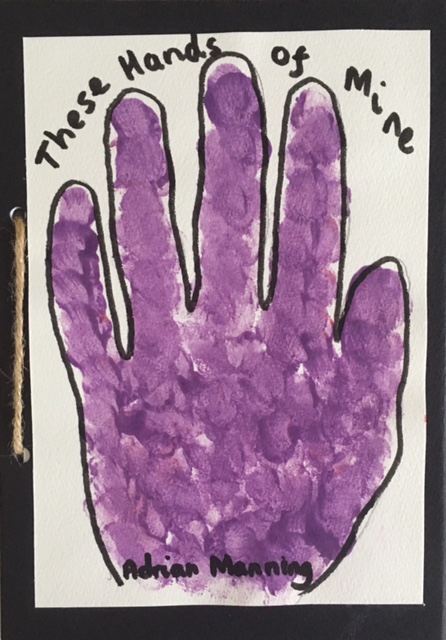
of These Hands of Mine (Concrete Meat
Press) and I did hand-crayoned abstracts in each of the first 50 copies of These Days … so yes, I guess I have
been very influenced by the poet/painters that I have come across! I like word
and images mixed together at times. Levy, Kenneth Patchen, William Blake and
others have done this well. I've been very fortunate to have the extremely talented
Janne Karlsson illustrate several of my poems and my chapbook Wide Asleep, Fast Awake, which I am very
proud of. It's something that works for me in the right conditions.
What is your opinion of the industries that
have grown up around some of the US beat writers, such as Kerouac, Burroughs
and Ginsberg? There also seems to be an industry around Bukowski.
 I like the fact that the interest around them
ensures that we keep seeing new publications of their work or writing about
them. What does make me sad is that the prices of the older books are so high
that average collectors cannot afford them! For example, the Bukowski books
with paintings!! These writers/poets became very well known and I admire and
read them all so I guess where popularity leads to money there is always going
to be those who seek to capitalise on it. I get saddened when I read of people
other than the writers themselves making vast amounts of money out of their reputation
and work. I'm not a capitalist, so anything like that does sadden me.
What projects do you have on the go?
 I've recently
published two short chapbooks ‒ Dreams
from Under a Rock through my press and 13
Poems from the Edge of Extinction, published by the wonderful John Burroughs
at Crisis Chronicles Press. I have some poems coming up in publications and I
am looking at a poetry reading coming up later in the year. I am
also hoping to jump on stage with the incredible Mountaintop Junkshop ‒ I read
a poem of mine in one of their songs ‒ soon.
I have been working
on a joint chapbook with an American poet that I hope will be out before the
year-end and I have some collections of poems that I would like to get out
sometime. I am turning 50 late this year, so I would like to get a selected
poems volume from the last 20 years together to mark the occasion ‒I may even
go for a paperback publication!
I will be completing
publication of further Solid Flesh For Food chapbooks ‒ Neeli Cherkovski, Linda
King, Catfish McDaris, Jake St John and the guitarist from an America
alternative rock band who I can't name just yet ‒ if it comes together! There
will be one more slot as I'll end on number 10 and that's undecided as yet.
I also contribute to a local Leicester
culture magazine called Great Central
‒ I have a couple of interviews ‒ one with a local band and one with a legend,
and some reviews I'm working on and whatever comes up with that ‒ so there's
plenty going on!


 In addition to full, perfect-bound collections, you have also had a number of chapbooks published. Do you prefer chapbooks over perfect-bound books? Do you think chapbooks have limitations? Chapbooks are not taken seriously here in South Africa.
 I am a huge believer in limited-edition books for several reasons. First, there is the investment factor, the whole collector culture, limited editions create a sense of urgency, people say, I have to have that, and I'm a firm believer in making sure my publishers at least break even and these days, thankfully, they tend to do a little better than that. Let's be honest, a lot of the people who look down on limited editions couldn't sell 120 books to their grandmother, anyway. What's really important is that the books that are printed reach the right people, those who really connect with what the author has to say, whatever they happen to take away from the work. I always tell people when I read in public that if I truly reach one person each time, then I take that as a huge victory. Also, like I said above, there's the work of art factor and limited-edition books usually fall into that category.
 I do travel a lot, I generally give around 100 readings a year. Sales are generally event-driven here too, though I sell a lot online as well. I wish I sold better in bookstores, though my local store tends to sell out of my work.