Showing posts with label South Africa. Show all posts

Friday, January 18, 2013

Haidee Kruger: Shaking language out of the furrows of habit

Haidee Kruger is associate professor in the School of Languages at the Vaal Triangle Campus of North-West University in South Africa. She holds a PhD in translation studies, and is primarily involved in research in descriptive and theoretical translation studies. Her poetry and short stories have been published in, among others, The Common,  New Contrast, New Coin and Green Dragon. Her work also appeared in Beauty Came Grovelling Forward, a selection of South African poetry and prose published on Big Bridge. Her debut collection of poetry, lush: poems for four voices, was published in 2007 by Protea Book House. lush was praised in the judges’ statement for the 2006/2007 Ingrid Jonker Prize as an "innovative volume of poems" that was "a close contender for the prize". The reckless sleeper (Modjaji Books, 2012) is her second collection.

Kruger lives in Vereeniging, with her husband and three children. She has a blog called Messy Things With Words.

DH: This may sound like a very basic question, but why do you write poetry as opposed to other forms? Why poetry?

HK: I wish I could write fiction, simply because so much of my reading life (as a child and an adult) has been shaped by fiction, and I have a very vivid sense of the way a story can open a door straight into another world. The best stories have gaps into which you can insert yourself and live there for a while. And when you come back from the story, you’re altered by it – in subtle ways it changes your relationship with the world in which you actually exist. It’s something I would like to be able to do. I’ve tried short prose forms – but I am hesitant to call them “stories”, because I’ve come to the realisation that my writing impulse is not driven by narrative, at all; my writing impulse is lyrical, in the sense of attempting to pin something very particular down in language. 

Also, for me, the textures, the endless possibilities of language, are a driving force in writing, and I think poetry, by its nature, is the form that allows exploration of this most fully. Language is always two things at once: a social thing which we use to communicate in the world, to convey ideas, to convince people of things, to get what we want; and a personal thing, which sits in our heads and is odd and peculiar and very individual. For language to be a useful social tool, we usually have to make it run in routinised ways, and get rid of some of the more confusing idiosyncracies, so we have consensus about what things mean and the world can keep on working. What poetry allows one to do is to shake language out of the furrows of habit, to see what new meanings emerge if you do unusual things with it. So poetic language is a way of pinioning down some aspect of the singularity of an experience, for yourself and for other people. It is the way that I continue to think about (good) poetry: holding a fascinating, unusual, intriguing language-object in your hands, turning it over, and then having it explode in your face with all kinds of unexpected meanings.

In your first collection, lush, the poems are experimental in form, but the overall structure of the book seems almost retro, with the poems divided into four sections representing four voices, with an opening and closing chorus. It gives the feeling almost of two approaches to poetry operating simultaneously, as in a relationship. Was this intentional? 

I don’t think creating this tension between the freer, quite experimental poems and the almost traditional structure happened intentionally – it’s maybe more of a collateral effect of something else I was trying to achieve. Looking at it now, I think the self-conscious structure, the creation of “voices” for the sections of the book was a way of building in a greater sense of “distance” into the book, as a counterweight to the often very personal poems. It was also an attempt at introducing order as a balance for the experimentalism in the poems themselves, to keep the collection balanced on a tightrope between freedom and constraint, between the very personal inside views of the poems and something more objectively interpreted from the outside. The voices, in this sense, impose a sort of thematic structure on the book, with each of the patron saints representing something of thematic importance in the book. So it is probably an attempt to keep the collection as a whole from flying apart into pieces. 

But maybe there IS something of these two broader approaches to poetry in the tension between the experimental poems and the more conventional structure. I’ve always been fascinated by how form shapes meaning – how restructuring the same experience into a sonnet or into free verse reframes the experience itself. Maybe some of that is in lush – how the macrostructure alters the interpretation of the poems as micro-entities.

Some of your poems remind me of e.e. cummings. What poets have influenced you? 

You’re right about cummings, who I never grow tired of. cummings understood best the idea of making language do new things, sometimes difficult things (for the reader), to chisel away at the accretions of habit in language, and shock the reader into a fresh perception of something. So its not experimentalism for its own sake, but experimentalism in language for the sake of experience. 

The question of influence is a difficult one. I think a lot of my influences are unconscious. William Gibson talks about cultivating a kind of personal “micro-culture”, and I think as a child mine was particularly rich in its indiscriminateness, made up pretty much of whatever I could get my hands on. The pleasure of words; the realisation that you can make language do things to make people feel things I think is something that comes from there. 

More specific influences: I think Eliot is the first poet I read who made me understand that poetry doesn’t offer emotion straight up on a platter – that the emotion is best when it is a hard, careful, pebbly thing that surprises you inside the language. But then I also for a long time loved Ginsberg, who is all about offering emotion up in big straight unashamed helpings. I have been consistently drawn to the poetry of Diane di Prima, Denise Levertov, Margaret Atwood, Anne Sexton. I am fascinated by the L=A=N=G=U=A=G=E poets – Charles Bernstein, Ron Silliman, Lyn Hejinian, Ted Greenwald, Robert Grenier. Their emphasis on repossessing the word as word, of experimenting with ways of making meaning that don’t take for granted any of the things we take for granted about language – syntax, sound, pattern, meaning, is something I am drawn to. I recently discovered the work of Marianne Boruch; the way in which she manages to combine a sort of effortless simplicity with the unexpected is something I find creeping into my own more recent work. 

In terms of South African poetry it is perhaps not unsurprisingly the poets who (sometimes) work along more experimental lines who appeal to me most – Kelwyn Sole, Kobus Moolman, Alan Finlay, Genna Gardini, Lesego Rampolokeng, Joan Metelerkamp come to mind immediately. But I also admire poets who perhaps work in a less experimental idiom but manage to distil something very pure from language – I think particularly of Gabeba Baderoon and Rustum Kozain.

You have, like many of us, quite a hectic lifestyle  – teaching at university, being a wife and a mother to three children. How do you find time to write? What are your writing habits?

I have lately had a voyeuristic obsession with writers’ writing habits and workspaces. I am particularly taken with the idea of a writing life – a daily routine structured around writing. But I’m not at the point where I can give up my day job and structure my life around writing; I probably never will be. I wish I could say that I set aside time especially for writing; that it is a craft which I have allocated time to specifically, because all craft must be practised and honed. At the moment, unfortunately, writing is something that happens in the cracks between other things… But it is also the case that when I have something in my head which wants to be written, I can relegate it to the bottom of a to-do list for only so long before it becomes very insistent. And then the writing schedules me, rather than I it.

Throughout history, society has held divergent views of poets  – ranging from regarding them as central, vital players in the community and/or respected dispensers of wisdom to regarding them as outcasts and useless dreamers who do not make any valuable contribution to society. I think at the moment it is very much the second view that is prevalent.  

This is such a complicated issue… In our time, it’s a fine line, isn’t it, between being a central, vital player in the community, and being a kind of commodity – because the kind of personality you project, the kind of poetry you write fits in comfortably with current discourses; fits current needs? There is an interesting take on this by Jeanette Winterson, talking about teaching creative writing: “Print media is shrinking, perhaps disappearing. At the same time, festivals and live events have never been more popular. Every tiny town seems to have a literary festival. Writers are out of the study and on the road – and when they are not entertaining readers they are invited to enlighten would-be writers. The most solitary of pursuits has become communal, organised, live, extrovert and competitive. Is this because writing has become a commodity – "cult cargo", as Val Mcdermid puts it?” 

I think there is something important in this. We live in a society which values visibility, extroversion, the ability to engage and entertain – and I think poets who are inclined, by temperament or by conscious decision, to leverage these qualities do manage to become “respected dispensers of wisdom” (not that I think that poets are any wiser than anybody else…). It also depends on the kind of writing – I think authors who see their role as social and inspirational find themselves naturally drawn to this socially visible role. 

I don’t really know the answer to this question. I know that writers have a very special ability – and I’m going to let Winterson (this time from her biography Why be happy when you could be normal) explain it again (because she does it so much better than I could): “All of us, when in deep trauma, find we hesitate, we stammer; there are long pauses in our speech. The thing is stuck. We get our language back through the language of others. We can turn to the poem. We can open the book. Somebody has been there for us and deep-dived the words.” I think for many readers the recognition of this ability is part of the value or worth that is ascribed to the writer or poet. But this value eventually becomes a commodity, up for sale and fetish, and that’s where things become complicated.

How does your new book, The reckless sleeper, differ from lush? The poems seem to be more personal, such as dealing with the experience of motherhood. 

I don’t think the poems in The reckless sleeper are more or less personal than the poems in lush –what is different is that with The reckless sleeper I have felt more willing to take the risk of letting the personal qualities of the poems simply be, instead of trying to build in the kind of dissociating devices I spoke about earlier. So The reckless sleeper is maybe less deliberately dense, more comfortable in its own linguistic skin than lush. But in many ways the books share a set of concerns: language, the body, desire, love, loss, home. Those unbearably human things.

In what direction to do you see your poetry taking? 

I have no idea – the words in my head fight it out and eventually decide their own direction; I’m just tagging along for the ride. I do know that for me there is a restlessness, in that there are always new ways of saying waiting to be made. But I am beginning to see that often I need to just cede the impulse to control and direct, and let the language do what it wants to do.

What are your views on SA poetry at the moment? As far as publishing is concerned, we are definitely in a pickle – publishers don’t want to publish poetry, the bookstores don’t want to stock it, and people don’t seem to want to read it. 

Yes, I think you are right that poetry (with the possible exception of Afrikaans poetry, maybe) is in a difficult position. I think poetry publishing in South Africa is actually at this point being kept alive by committed, passionate independent publishers like yourself and Colleen Higgs (and others) – who have worked out some pretty effective guerrila tactics to not only keep poetry publishing going, but to try to allow it to develop and expand and include a range of voices. 

Despite these efforts, the market for poetry (in the form of books, or journals, or online subscriptions) is small – there is a very small percentage of South Africans who value written poetry enough to buy poetry books or subscribe to poetry journals. So mainstream publishers are careful, and for preference only publish either well known poets, or poets who have the potential to sell well because their work speaks to a readership’s desire to be entertained, comforted or inspired. Publishing new poetry, or experimental poetry, has been relegated properly to the fringes. Because it won’t sell. And so a kind of impoverishment of poetry publishing sets in… But it is also true that poets have many more outlets than just print – Internet access in South Africa is growing, and most of this growth market access the Internet via their cellphones. So there’s a growing platform for poets there – once one is willing to let go of the traditional attachment to the book. 

To take this back to your earlier question: There is an odd contradiction here, in that clearly (some) poets are idealised to some degree in South African cultural consciousness, but this does not necessarily translate into actual buyers of poetry books. Which leads me to think that maybe it is not the poetry itself that is valued, but what the poet represents in the popular consciousness – a popularly defined role with which I think many poets do not always feel comfortable. 

But I feel one should put this in a larger perspective too: one cannot view these issues as separate from the difficulties that South Africa faces in terms of literacy, reading, education, poverty, etc. These material factors obviously condition the market, so it’s not fair to simply berate readers for not buying books… And while one is at it, one should spare a thought for African-language book publishing, which is (outside the educational sector) miniscule; wholly out of proportion to the potential readership. So the problems are much bigger than people just not buying poetry books…

Wednesday, February 22, 2012

Dawn Garisch: observing the patterns

Dawn Garisch lives in Cape Town and has had five novels and a collection of poetry published. Three of her novels have been published in the UK. In 2010 her novel Trespass was short-listed for the Commonwealth Prize in Africa, and in 2011 her poem Miracle, from her debut collection Difficult Gifts (Modjaji Books) won the EU Sol Plaatjie Poetry Award. A nonfiction work, Eloquent Body, will be published by Modjaji in March. Her work has appeared in literary journals such as New Coin, New Contrast, Carapace and Green Dragon. She runs workshops on writing and creative method, and is a practising medical doctor.

DH: How did you come to writing? Has your profession as a medical doctor influenced on your writing at all?

DG:I have always had an affinity for books and writing – I demanded to be taught to read at a very early age and wrote my first poem at seven. Left to my own devices, I might have become a librarian, but life had other plans for me. My family decided I would do medicine, and I fell in with their ideas. The split I have felt between my calling as a writer, my training as a scientist and my interest in psychology has provided a tension in my life which I have attempted to resolve on the page in my forthcoming nonfiction book Eloquent Body.

A doctor is in a privileged position of having access to intimate details of people’s lives. This has deepened my understanding of human frailties and strengths. In the consulting room I have also been able to observe the patterns we set up for ourselves, and how we often do not act in our own best interests.

Medicine has enabled me to work part-time, and to keep the space open to write.

You are known mainly as a fiction writer. How do you see the relationship between fiction and your poetry, particularly with regards to your approach to the two genres? I am thinking of how Lawrence Durrell said something to the effect that novels are like lorries, but poetry is like an arrow.

I like that! I experience poetry as an instant download, which I then have to work out further on the page, whereas a novel is like finding the end of a thread and following it on down. Both forms ultimately contain the pleasure and the difficulty of trying to solve a problem that lives simultaneously inside myself, out in the world, and on the page; each offering I bring into being is a part-answer to the puzzle of who I am and what the world is about.

What writers have influenced you – fiction as well as poetry?

So many: Lewis Carroll, Virginia Woolf, Patrick White, Ted Hughes, Doris Lessing, Margaret Atwood’s poetry, Joan Metelerkamp, Salman Rushdie, Tsitsi Dangarembga, Sharon Olds, Tristan Tzara, Marion Milner, Ivan Vladislavic, Mxolisi Nyezwa - to name a few who changed the way I thought about writing. Who opened doors in my head and my heart. Who gave me permission to experiment.

In your poetry collection Difficult Gifts, there are recurrent images of searching, of journey, of opening and discovery, as well as intimacy.

I write out of disturbances that arrive in my body. Sometimes the disturbance is unbearably beautiful, or it arrives out of enormous difficulty. Writers who have affected or influenced me have written as honestly as possible from an intimate space; they have helped me respect my body as an antenna or radar, and offered a chink through which I could view what is happening beneath consensus or veneer.

If I take a step back and try to see what I have been doing on the page when writing poetry over the years, primarily it has been a medium through which I try to find out what I am feeling and thinking – a discharge of tension which sometimes speaks to other people, and then finds its way into print. I think that underneath many of my poems is a conversation I constantly have with the creative process itself – The Edge, Great Fish, The Proper Use Of Flowers, Making Fire, Difficult Gifts these and others are about what they purport to be, but also about the urge and search for connection with the creative force itself. I see desire, sex, libido, love and creativity on the same continuum – the trajectory that must look elsewhere for completion, the driving spirit behind life itself.

Your poem Miracle, from the collection, won the 2011 EU Sol Plaatje Poetry Award. What is your feeling about literary awards in SA? Do we have enough or too many? Should we have more genre-specific awards?

I feel split about poetry awards. On the one hand it was wonderful to have that acknowledgement, and I am immensely grateful to the European Union for their vision of encouraging diversity of cultural expression by supporting the least valued and possibly most ubiquitous art form: poetry. On the other hand, it did feel uncomfortable to be awarded ‘best poem’. Best collection of poetry is more understandable, and easier to judge, I imagine.

Awards do create a bit of a stir, and they hopefully encourage people to support local writers. We have much more talent in South Africa than people realise. My first drafts of Eloquent Body contained quite a number of quotes and extracts of poems from writers abroad. When we applied for permission, many publishers wanted prohibitive royalties. So I again turned to local poets, and spent weeks reading, trying to find suitable replacements that complemented the text. Although I do regularly read local work, I was astonished by how much truly stunning poetry had escaped my attention. And the local poets were only too willing to let me quote their work in the spirit of collegiality.

What are your thoughts about publishing in SA? A few years ago, when the Kindle first came out, there was a feeling that e-readers would not take off in SA. Now sales are rising...

If e-publishing allows writers to flourish, that is great. Personally, I still like the feel and smell of a real book, and to have tangible old friends sitting on a shelf near me in my study. And as someone pointed out, you cannot lend out a downloaded Kindle book. It is attached to the gizmo. Another said, when all books are virtual, how will we decorate our walls?

Publishing in SA took off after 1994, but now in the recession, I have the impression that it is slowing down again. Both impetuses are perhaps a good thing – initially broadening what South Africans write about and what kind of work was published, and now tightening up, making authors work harder to improve what they are doing.

What do you feel are the main challenges facing writers in SA?

There is much interesting writing coming out of SA; the question is how to get noticed in the great overwhelming sea of mega-publishing. I have the notion that most readers do not hone in on literature or any other art form as a way of finding out what artists are reporting back on. Readers buy newspapers regularly to see what journalists are saying about the day-to-day state of the world; they need to understand that artists are reporting back on the Zeitgeist the themes and spirit of our times. If readers took art in all its forms as seriously as they take the newspapers, they would, to my mind, be better informed. In addition, our writers and artists would attain the recognition they deserve.

What about you busy writing at the moment?   

I am putting the final touches to Eloquent Body, and catching the odd poem when it falls. I have started two novels, both of which intrigue me. One is a reworking of Mary Shelley’s Frankenstein in the biological age, and the other is an exploration of love in all its guises. In both, I am eager to find out what is going to happen next. One of them will have to wait for a year or so in the bottom drawer...

Saturday, January 7, 2012

Mxolisi Nyezwa: A new dawn for poetry

Mxolisi Nyezwa was born in 1967 in New Brighton, Port Elizabeth, where he still lives. He is the author of song trials (Gecko, 2000), New Country (University of KwaZulu-Natal Press, 2008) and Malikhanye (Deep South, 2011). His work appeared in the bumper poetry anthology Essential Things (Cosaw, 1992) and has been published in numerous literary journals. He is included in the selection of South African writing, Beauty Came Grovelling Forward, on the US-based literary website Big Bridge. He is the founding editor of Kotaz, a cultural journal.

DH: You were published in the Cosaw anthology Essential Things, in 1992. The sections allocated to each poet were quite big, actually small collections in themselves. You had thirteen poems under the title ‘To Have No Art’. What was your position as a poet back then?

MN: The 80s and 90s were confusing times for many young people in the townships. I had just completed my matric in New Brighton during the most painful and dangerous of times. My school education had proven to me to have been a complete waste of time. The useless piece of paper from the Department of Education and Training, my certificate, stayed for years in one of the old sideboards at home to mock me for my gullible dreams of material or vocational success. In my case the apartheid dream of educating blacks for subservience succeeded. Like a hunted animal I was cornered, gravely concerned about my future, unprepared for the emotional and psychological violence – the steep darkness that was to engulf my life later on – outside the familiar and troubled neighbourhood of New Brighton. So when I wrote my first poems I was creating for myself some distance from this encroaching and awful world of manhood. I was looking for light where I sensed darkness lived, listening for the comforting sounds of words and unaffected spirits. In the 70s Serote had written No baby must weep. He had focused us to see love away from pain and struggle and demonstratively spoke of the maternal instinct in his heroic poem Behold mama, flowers. Under those harsh circumstances of my growing up, poetry became the only accessible language that could talk profoundly and in a way I could relate to about my need for complete meaning, my thirst for direction amid the noisy messages that had been drummed into my ears during my school years. From early on I could not shake off the disturbing feeling that I was in somebody’s crooked plans, that I was fingered, or even that people from somewhere with long, nightmarish dreams were looking for me. I was paranoid. Once, I took all my poems and buried them into a deep hole in our backyard. Amid all these conflicting emotions I arrived at the doors of Cosaw in Korsten, maybe a few weeks or just days before Cosaw closed down. So I was never really part or even that exposed to Cosaw’s culture and activities.  I had submitted my first poetry manuscript to Ravan Press in Joburg. In fact it was from a letter from Ravan Press (Andries Oliphant was their editor) that I first learnt about Cosaw’s existence, and of the plan about Essential Things.

Your first collection, song trials, appeared in 2000 by Gecko. What struck me at the time was the strong sense of bleakness in the poems: there are references to night, darkness, rain, birds, thunder. There seems an atmosphere of desolation and isolation. Already, in the title poem of your Essential Things selection, you had stated ‘I hate the sunshine.’

On their own these references to night, darkness and so on are not exceptional, not in any poetry. It is the context around the imagery that gives the work this other feature of desolation and bleakness.I think therein lies sometimes the value of poetry, because these references are about lived experiences. Experiences that others are being exposed to that none of us may be aware of.

I like to think of my poetry as reflecting the dismal nature of politics and individual existence in the modern society, a reflection on greed and how capitalism and the financial system have devastated people’s lives and cultures without shame. Poetry that identifies this kind of aggression, which is really driven by financial interests as the basis for corruption against human beings, must necessarily be bleak. The poetry must in turn invoke its unique form, impact the usual language extraordinarily, enmeshing flowers, human lives and global manifestations. In so many ways poets are writing to change the world.

In New Country there are indications of a willingness to experiment with form – I am thinking of the long poem 'Sky', which ends with the word ‘rain’ being repeated 88 times, like concrete poetry. There is also the prose piece ‘it is good’, which is a one-paragraph rush without punctuation.

It’s difficult to explain why some poems have to appear in the world the way they do. The challenge for the writer is to stay close to what comes, the primeval music and sound of the poem, its primary bend towards its own unique shape and form, and its own language. Obviously there are always risks involved in this process of transcribing the original voice of creation or composing each new poem. The risks confront all poets. For a poem like ‘Sky’ it was important for me to be expansive in my use of imagery and still maintain movement through the poem. That is what the poem seemed to be saying to me. The poem was taking me everywhere. Its music tugged closely at my arm and pulled me towards desolation and to lonely places, to directions and oppressed geniuses, to bewildered and unfriendly people working under the midday sun. The poem pointed at the whole universe. I saw all manner of things, many lives, some begging to be heard; others that were forgotten and shameless.  I think the last stanza with the long repetition of the image of falling rain tries to celebrate these multiple existences.

What have your poetic influences been? When we were at Poetry Africa together, we chatted quite a bit about the modern Spanish-languages poets, such as Neruda, Lorca and Alberti.  But you were particularly keen on Vallejo. 
  
I like Neruda for his over-exuberant passion, his huge love for life, his strong desire to reach and name all things. Vallejo’s love walks boldly to us through another door, one we never expected. His devotion to humankind is more fundamental, much more intense, even psychotic. Lorca taught me at a young age the use of imagery. His poem Lament for Ignacio Sanchez Mejias revolutionised my thinking about poetry and its application in human affairs. I’ve always been attracted to writers and poets who wrote as if the entire meaning of their lives dependent on it, on their calling as poets or as writers. I regard Eskia Mphahlele’s Down Second Avenue as one of the most important books to have been written about South Africa and its people.     

Your new collection, Malikhanye, is centred around the loss of your infant son in 2007. There is obviously an expression of loss in the poems, of being ‘haunted by the life we never had’. There is also a directness I do not see in the earlier poems.

I have a feeling that the more direct my poems become, the greater are the chances that they will lose their power. I must avoid ‘directness’ at all costs as the approach goes against my understanding of how life manifests ordinarily. Life works the same way as death works, applying its innuendos and subtlety. I think the obvious misleads, gives the wrong answers. What becomes crucial is finding new paths, discovering for ourselves new rhythms, new nuances. That becomes important. For a fuller representation of loss in Malikhanye I had the sudden revelation that life complicates and yet simplifies. That even as we begin to think we understand, everything around us explodes or diminishes – all understanding, every organic leaf, every rock, like rain patterns against the sea. Malikhanye was driven by the intense feeling of loss. Everything was out in the open. A mad nanny had left the boy alone to die. There was nothing philosophical about that. The truth was out in the open.

You have lived in New Brighton, Port Elizabeth all your life. How has New Brighton informed your poetry, apart from the obvious coastal imagery? Have you never felt attracted to moving to one of the cities?

I don’t think I have the means to move to any other place, well, maybe, because I have now a wife there can be possibilities. Because I am now learning with a wife that one must be communal in thought and not only think for oneself. You’re now with somebody else, and you’re partners in marriage. This always comes as a surprise. But really I wouldn’t like to move to anywhere else. New Brighton is my home. Poetry found me in this place. I feel very close to my ancestral spirits here. Even when we depart I will always come back here.

In South Africa we are struggling to sell poetry. Few bookstores are interested and poetry is rarely reviewed. Yet some events, such as the recent Melville Poetry Festival, have been very successful, and brought audiences who not only listened attentively to the poetry, but also bought books. Do you think events at which to promote and sell poetry have become more crucial than ever?

Yes, certainly. In fact, in March, with a group of local writers in New Brighton, I’m putting together the Nelson Mandela Bay Book Fair, a small-scale books and exhibitions event to focus our community in Port Elizabeth and around the Eastern Cape on buying and reading books. It is true that bookstores are not interested. I think they have their own issues to deal with, surviving and making a profit. There are just too many factors involved. There are problems in education in our schools, the huge inroads that technology and computers have made into people’s lives, the shortening and narrowing of time and the massive pressure this puts on individual lives, and so on. All of this ultimately marginalises reading and books to a secluded area reserved only for devotees and higher culture. Reading books has been turned into an elitist activity.

For how many years has your cultural journal Kotaz been running?

Kotaz began in 1997 as a quarterly publication, so the magazine has been around for about 14 years. I don’t think I ever saw the publication as a business. I didn’t do a public survey about the need for the magazine, no research about other publishers, had absolutely no idea about distribution and was deeply ignorant about production and other costs. In 1997 I didn't know about funders, I wasn't aware of their addresses and their ethics – that South African funders often behave like a spoiled mistress, that they have extraordinary moods and must be managed or sometimes come at a price. I prowled like an injured animal the UPE University computer labs in Summerstrand for a computer monitor. I invaded higher education, hanging around the corridors waiting for the right time to enter the labs disguised as one of their students to gain access, and use a computer. All this time I had my bag with me filled with manuscripts, poems and texts scribbled on notebooks and on torn paper by writers from the township (some I knew, the majority I didn’t know) to type and save on a floppy disc. These were the humble beginnings of Kotaz. Funding, in dribs and drabs, only came in much later. A few years later I realised I could not sustain my hustling activities at the universities. Saving poetry this way was draining me. My cover was blown when some English Department people at Vista University recognised me from somewhere, and enquired if I was now a student, which I wasn’t.  

The next issue of Kotaz will come out in mid-February, this year. I stopped long time ago pretending that Kotaz is a quarterly publication because I found that the financial challenge of publishing the magazine four times a year was just too much.

What is your experience of obtaining funding for publications in South Africa? Do you find it easy or difficult?

It is a tragic consequence of our new democracy that even poetry has managed to attract the wrong crowds. I suspect that most followers come to poetry for the wrong reasons, to make money, to start a publishing business, to workshop writers, to boost their stardom as celebrities or divas, to get into radio and TV and have their own shows, and so on. Now all this is really harmful to South African literature and is killing our poetry. Even government funding for the arts becomes clouded by all kinds of trends and interests, mostly pretentious and insincere. I think most serious poetry journals and magazines, Kotaz included, are really struggling to get any funding. There are so many hypocrites walking around pretending to stand for poetry and getting large chunks of state funds for it. Again there’s the other problem of the government not taking the arts seriously. I’ve often heard that money earmarked for funding the arts often gets diverted to other departments. 2012 should be another dry year for poetry with the centenary celebrations of the ANC taking place.

To your mind, what are poets in South Africa doing at the moment? 
I think poets are using language to unravel the political myth, to say it was not by promises that we found a thriving democracy. Their language seeks to remind of sacrifices that were made by so many in order that freedom and justice for all could be realised. At the same time poets are speaking against those who constantly yearn for the past, black night that was besieged by black night. I think these are matters that must come out strongly if we think of a new dawn for poetry, a new chapter for South African literature and culture. 


Malikhanye is available from bookstores at a retail price of R95, or direct from Deep South's distributors, University of KwaZulu-Natal Press. 

Saturday, August 27, 2011

Gail Dendy: Dancing in verse

Gail Dendy is the author of seven poetry collections, the latest being Closer Than That, published by Dye Hard Press. She was first published by Harold Pinter in 1993, with her subsequent collections appearing in SA, the UK and the US. Her poetry and, more recently, short stories, are regularly published in journals and anthologies. An internationally trained dancer, she helped pioneer Contemporary Dance in SA between the late 1970s and the early 1990s. Other passions are environmental- and animal-rights issues. She lives in Johannesburg with her husband, pets, a law library, and a huge rock ’n roll collection.

DH: Your first poetry collection, Assault and the Moth, was published by Harold Pinter, through Greville Press in the UK, in 1993. How did that come about?

GD: By accident! My husband and I were living in London for a year, and I set myself the task of completing a poetry manuscript and submitting it to a British publisher. Well, I completed the manuscript, and when it came to sending it off, I had no idea where to send it. So I bought a copy of Macmillan’s The Writer’s Handbook and sent the manuscript to various publishers as listed, mainly in London. One press I chose was ‘Diamond Press’ – I figured that, since diamonds have a South African connotation, this might be a lucky press to go with. So I sent it off to the contact person, in this case Geoffrey Godbert. Soon after, I received a postcard saying Diamond Press didn’t publish poetry (Macmillan was wrong!), but that he, Geoffrey, was an editor of another press called Greville. He said that so far two of the editors were enthusiastic about my work and that the third editor now needed to look at it and give the final say. The second editor was Anthony Astbury and the third was Harold Pinter. Eventually, I got a 3-out-of-3 approval, something that was apparently very rare in Greville Press. Ironically, as a student I’d been nuts about Pinter’s work, so you can imagine how incredible it was to know he’d read and admired my work. He later wrote me a letter saying that he ‘wrote [to me] as my publisher’ and was delighted to have published my poems.

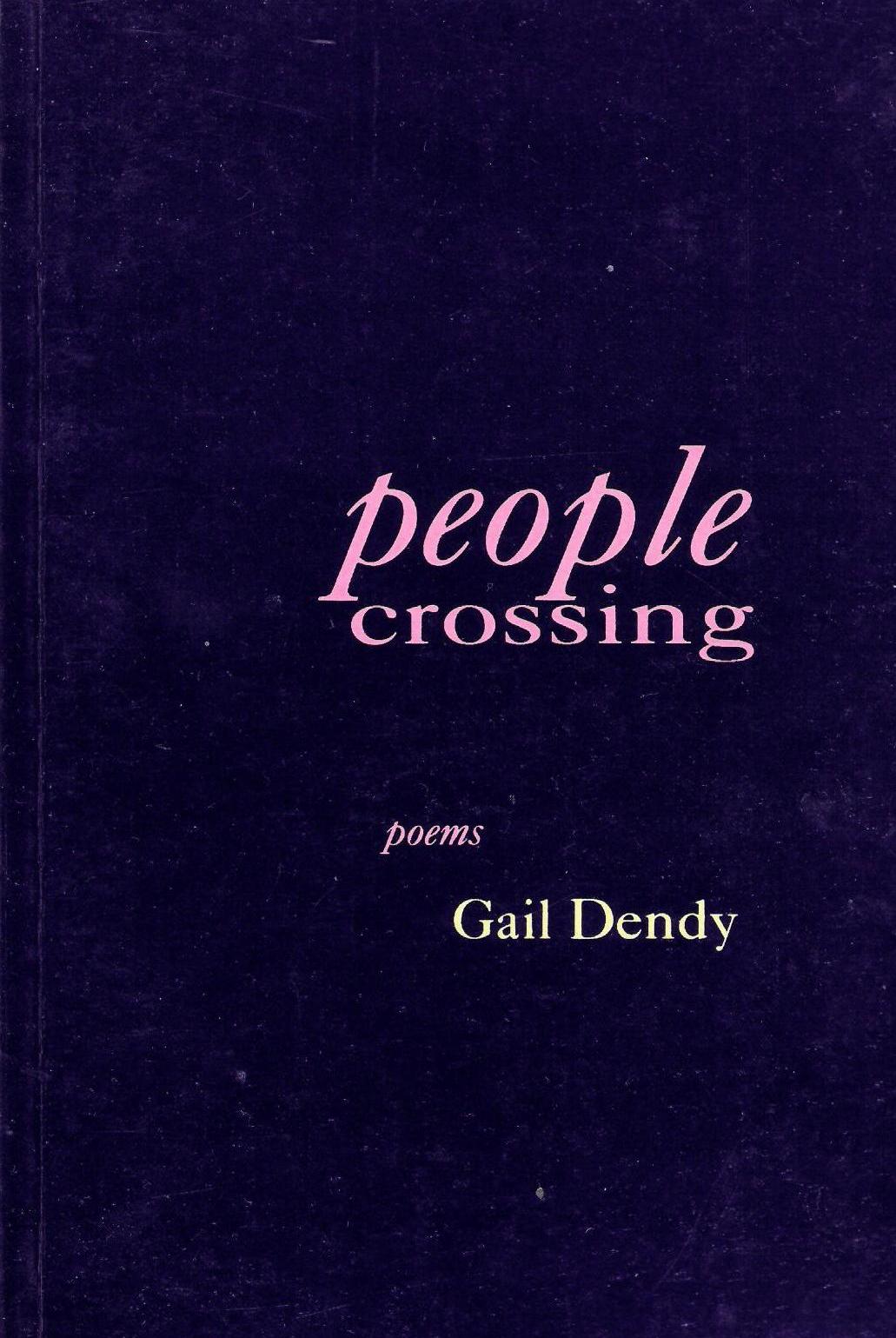
In your second collection, People Crossing, there is a poem called ‘Assault’ which immediately reminded me of Sylvia Plath. What poets have influenced you – has Plath been an influence?

I read Plath as a teenager, but ‘Assault’ is a poem that just happened, its genesis being that dreadful case of those six young girls who went missing in the late 1980s. It turned out they’d been kidnapped by a notorious paedophile and his mistress. None were ever seen again. So I was thinking about child abuse at the time I wrote the poem. I often use a strong voice in my work, as did Plath, and given that I use family members (mother, father, sister, brother, cousin etc) as literary symbols, people might think I’m writing confessional poetry. Nothing could be further from the truth. My poetry is almost entirely fiction. My influences, though, are varied – anything from ancient Chinese poetry onwards. In 1991 I discovered Carol Ann Duffy, and felt there and then she ought to be the Poet Laureate. In homage to her, I based the cover of People Crossing on her book Mean Time. It feels good to know that I was in some way prophetic.

Your work focuses on the immediate and the familiar, but there is also a sense of the magical in some of the poems. What inspires your poetry?

I draw a great deal on biblical and literary references, fairy tales, myths, dream imagery and fables, so that probably accounts for the ‘magicality’. Rhyme (either internal or asymmetrical), rhythm and cadences play a huge part in my work, which is perhaps not surprising given that I’ve been a dancer and that dance is still so important in my life. Ditto the musicality of words and language. It sometimes gets to a point where I know exactly what vowel sounds I need in a line to make the ‘music’ that seems right for the piece I’m working on, but it’s the damn consonants that give me trouble.

There is another poem from your second collection, called ‘Tourists’ which deals with an incident where two tourists were murdered on a Natal beach, in 1992. But the ‘outside world’, if I may call it that, of socioeconomic and political realities, doesn’t really play much of a role in your poetry.Is this something you consciously avoid writing about?

Actually, I’m very aware of the outside world and confess to having become quite a news junkie in the past 10 years or so. What I prefer to do, though, is to personalise and individualise the external world so as to distil an emotion or set of ideas from it. I admire people who’re able to write meaningfully about socioeconomic and political reality, but I could never sit down and say to myself: ‘Today I’m going to write a poem about the earthquake/tsunami/civil war/rebel uprising …’. If I did, I’d probably end up with little more than a news report. What’s so exciting about poetry is that you can create an entirely new world parallel to, and resonating against, the real world, but one that has its own logic and rules of engagement.

Do you think poets have a ‘role’ to play in society, and if so, what?

I’d personally feel very arrogant saying that poets have a role to play as if they were somehow superior beings. On the other hand, I strongly believe that the arts, generally, are necessary and relevant in creating a well-rounded, vibrant society. People turn to the arts for an enhanced emotional experience, and perhaps to connect with what has proved to be both timeless and universal. For instance, I read somewhere that during World War Two more people visited London’s National Gallery than ever before. I like to think that more people bought and read poetry, too. Poetry offers a unique window onto the world. It would be sad if that window ever became boarded up.

Lately, there has been quite a bit of discussion about the diminishing space given in the media to book reviews, particularly poetry. Bookstores are becoming reluctant to stock poetry – they say it doesn’t sell. And so publishers don’t want to publish it. And certainly, from my experience, I see a lot less readers of poetry than there was about 10 years ago.

It’s very worrying that poetry is becoming the Cinderella of the arts. Everything works in a vicious circle in that the lower the profile of poetry, the less market there is for it, and the less interest there is for publishing houses to deal with it and for bookshops to make it available. But hopefully the cycle will, at some point, start turning the other way. Wouldn’t it be terrific if poetry made headline news, and if you had to book your seat a year in advance to attend a poetry reading or book launch? Oh, and pass me that glass slipper, will you?

Closer Than That is your seventh collection. Of your previous six collections, two were published in SA, the others overseas. Were the overseas publications available here? Does it bother you that most of your collections have been published outside SA? Do you think it has weakened or strengthened your reputation here, or does it not matter to you?

They weren’t readily available here, unfortunately, although obviously they could be purchased from an overseas source. I particularly wanted to be published ‘overseas’ as I was getting such positive responses from that initial manuscript I sent out (the original full-length Assault and the Moth). It was Gus Ferguson who introduced me to the South African audience, for which I’m eternally grateful. But I’m not sure I even have a reputation here to be strengthened or weakened. All I know is that I write what I write, and I write what I like.

Your story ‘The Intruders’ appeared in the short-fiction anthology, The Edge of Things, published by Dye Hard Press. Here again there was a sense of magical realism, with an interplay between outer and inner worlds. Does magical realism  play a big role in your short fiction as well?

Surprisingly, it does. Surprising to me, that is, as I never consciously set out to incorporate this element. It can be seen in ‘Wayfarers’ (2007), and also in 'Venus Crossing' which was shortlisted for the Thomas Pringle Award 2010, so it seems people are liking what they read. But allegory also slips into my prose without so much as an invitation. I specifically used it in a 2007 publication called ‘The Briar Hedge’, and of course both magical realism and allegory are highly visible in ‘The Intruders’.

What are the main challenges facing poets in SA? Getting published is obviously one of them.

It’s the old story of there being no shortage of poets, but a shortage of readers. So the huge challenge is to find vehicles for communicating one’s work. I’ve been a bit lucky in the past couple of years in being able to perform in productions which we call Off the Page, together with a wonderful pianist, Tony Bentel, and an experienced broadcaster and raconteur, Selwyn Klass. In our last Off the Page we added a cellist and flautist. We script the work very tightly, and are fully rehearsed. We’ve had some excellent audiences, and terrific feedback. Will that induce people to buy and read poetry? Probably not. And there’s the rub.

What do you regard as recognition?

I would say the ultimate form of recognition is having someone come up to you and say they can’t wait to read your latest poem, or – even better – your latest book! And believe it or not, that has actually happened to me. I just hope I wasn’t dreaming.

Closer Than That is available from Exclusive Books throughout SA, estimated retail price R105. It can also be ordered  from Dye Hard Press for R85 (including postage) in SA, or for R115  for overseas. Email dyehardpress@iafrica.com for order details.   

Friday, May 13, 2011

Kobus Moolman: Defending the value of poetry

Kobus Moolman has published several collections of poetry, including Time Like Stone, Feet of the Sky, 5 Poetry (with others), Separating the Seas, and most recently, Light and After (Deep South). He has also published two volumes of drama: Blind Voices and Full Circle. He has been awarded the Ingrid Jonker prize for poetry, the PANSA award and the DALRO poetry prize. He lives in Pietermaritzburg and teaches creative writing at the University of KwaZulu-Natal.

DH: Your first book of poems, Time like Stone, was published in 2000 and your latest, Light and After, in 2010. Over the ten years, how do you view your poetry as having progressed?

KM: Phew! Has it progressed? Has it maybe just changed? Has it maybe even stayed the same? The same concerns. The same small patch of earth I’ve walked round and round. The same dry bone I’ve come back to gnaw.

One thing I do think has happened is that I have learnt ‒ am learning ‒ to trust more. To be less obsessed with wanting to know what my poems are about, what they mean, as I write them, to want to know what I am writing about as I write, and just to write. To write and let the words speak. To efface myself. To trust that the words ‒ words, language ‒ have their own in-built system of purpose and beauty and strength. And that the more I allow this natural element within language to speak, rather than trying to force the words to say something deliberately, the stronger will the eventual product be. It is almost like writing with my eyes closed. Like walking with my eyes closed. And only knowing what I wanted to say once I had said it.

Yes, of all the things that might have changed in these ten years, this is it. The overwhelming sense that I don’t know what the hell I am doing. But that it doesn’t matter. That doubt is more important than certainty. That the spaces and the emptiness and the holes in a poem are just as important as the solid and tangible things.

Many of your poems seem to becoming shorter, tighter, and more economical with words – in fact some are like word snapshots, a bit like the short poems of William Carlos Williams. Has he been an influence on your work? What poets have influenced you?

William Carlos Williams has not been such an influence upon me. I have read his work, but only in snatches. This economical style you speak about is probably more the influence of writers like Paul Celan. And Anne Carson, who, although she writes long poems, is always absolutely precise. There is nothing that is not absolutely essential in her lines. Everything counts.

Celan’s apparent obscureness (his difficulty) fascinates me. I come back again and again to his work and always find new experiences. Not new meanings. I don’t know what his poems mean. But there are new worlds of experience, new sensations.

And then there are a whole host of other poets whose work and whose lives have fed and enriched my practice. Locally Karen Press, Tatamkhulu Afrika, Don Maclennan, Joan Metelerkamp and Rob Berold have been huge influences. And internationally it’s Lorca and Nelly Sachs, Ingeborg Bachman, Johannes Bobrowski and Yannis Ritsos, Yehuda Amichai, and Erin Moure, Nicole Brossard and Alberto Rios and Miguel Hernandez. The list goes on. The list changes, and gets updated and revisited.

You live in KwaZulu-Natal, whereas a lot of literary publishing tends to be located more in Johannesburg or Cape Town. There used to be a sort of cultural tension between Johannesburg and Cape Town, which I think has now diminished considerably. Do you think there is still some regionalism in South African writing and publishing? Is regionalism a negative thing, or can it be positive?

Yes, I think there is a kind of regionalism. At least a sense that JHB and Cape Town are where things are happening and that the other centres don’t really exist. Or don’t matter. Or don’t get as much serious attention. But there are also equally other centres of poetic power – like Grahamstown, and Elim (around someone like Vonani Bila). Even Durban – the Durban of Douglas Livingstone and Fernando Pessoa. It is an odd thing, this conglomeration of writers in particular places. And then the sense of egoism and even hubris that builds up there. And it is very, very hard to decide whether one should be part of those centres, be there, sharing, participating. Or not. Whether one can in fact, perhaps not necessarily write, but be published and be recognised and accepted outside those centres. I don’t know the answer. Sometimes I do feel on the periphery. And sometimes not. Sometimes it doesn’t matter. And sometimes the very notion of a centre and a periphery is meaningless. It disappears, and there is just writers. Universal writing.

For 12 years you published a print literary journal, Fidelities, twice a year. How did it start up? Print literary journals now are becoming scarce in South Africa, hardly anyone seems to want to buy them.

The first issue appeared in 1994. It really began like most good things after way too much to drink. A close friend Richard Walne, who sadly died a few years ago, and I were involved in planning an arts festival in Maritzburg. And one night we were sitting around drinking whiskey and he suggested we put together a journal of local poetry for the festival. Well, this was the first edition of Fidelities. We did it together for two years and then Richard moved town, and I just carried on with it. It slowly grew to being more than just local writers, firstly just around KZN, and then nationally. It was really good fun in its heyday. I enjoyed finding all these strange unheard of writers. I enjoyed providing a platform for their work. But eventually a whole lot of negative factors began to tip the scale. I had originally got support from the National Arts Council, and then when this faded I managed to get support from the local city council. And that worked very well for a while. But eventually that too stopped. There were hardly any subscriptions. Some sales, but not enough to support the production costs. So I was eventually funding it myself. And then the time required for the magazine also eventually began to tell. And it ceased being fun. It was like some kind of obligation. And so I eventually let it go. That was in about 2007, I think. Now and then I do miss it. I miss the little community of writers, of likeminded people that congregate around a magazine – Green Dragon has them, New Contrast too. And there is some kind of feeling of closeness, a certain solidarity among them. I like this.

The issue of print publishing  leads onto the issue of online publishing and e-publishing. What is your opinion on this?

I don’t really have an opinion. I don’t unfortunately use online publishing that much – or read material online. I’ve never read a book online. It’s not snobbishness, nor even some kind of Luddite prejudice. I just haven’t got into it. I still like the smell of a book. But I don’t have a problem with online publishing and e-publishing. It’s another resource for people. And that’s fine. It’s just not one that I am comfortable with – from a practical point of view. I don’t know if this question of yours is also meant to probe the future of the book, and of bookshops. And here I would have strong feelings. It is clear that we cannot go back to some kind of mentality pre the Kindle etc. That is reactionary. But like newspapers, and all other print media, books and bookshops are going to have to find some kind of strategy of survival, some niche that they occupy alone, and that they can aggressively sell. I grew up in bookshops. My greatest pleasure in life is to sit on the floor in a bookshop, behind a high shelf, and to make a pile beside me of options: this or that, this or that.

You teach creative writing at the University of KwaZulu-Natal. What sort of contribution does teaching creative writing at tertiary level make to South African literature?

I don’t know that our job as teachers of writing is necessarily to turn out writers. This might sound odd. I think writing courses – and specially accredited ones that give the student a degree – can give people false hopes; can give them a whole lot of expectations that simply will never be met out there in the big real world. Quite simply not everyone who attends a writing class is a writer. Just as not everyone who studies history is going to be an historian. People study history, and writing, for a whole lot of other reasons than simply wanting to be an historian. Or wanting to be a writer. And this is right. This is good. There are a whole lot of other skills and forms of knowledge that are acquired in the process, apart from a very narrow focus on the demonstration of the ability to be a writer or historian or mathematician, etc. We learn what goes in to making a poem or a novel. We learn what is takes to be able to make a poem. We understand the process. And this is vital in making us better readers; more able to appreciate what other writers have done. So I think this is what writing courses, degrees in writing, can contribute. Apart from just churning out a whole lot of writers – which is unrealistic.

You did some creative writing workshops in prisons back in the late 1990s. What was that like?

Teaching in prisons has taught me a lot about our prejudices towards people, the way we stereotype ‘the criminal’. In most case what really shocked me about standing in front of a class of inmates was actually that there was very little distinction between myself and them. Between them and the warders. In many cases (of course not all) it is often just wrong decisions. And we all make wrong decisions.

And then also teaching in a prison – particularly teaching writing – has really brought home to me the fact that literature is not an elitist activity. That it has got nothing to do with intelligence or cultural sophistication. I have read Wopko Jensma to men and women inside, and they got it! They have understood what Jensma was saying much better than many third- year English students ever have. The inmates felt what Jensma was saying. Many of the inmates were enormously receptive to studying and then writing poetry, precisely because they understood the value of poetry. They understood what poetry could do for them sitting inside. It was and is a vehicle for understanding themselves, for understanding and expressing who they were.

An issue that has been cropping up lately is the question of whether South African readers – and writers – are losing their sense of critical evaluation, for a number of reasons. While I think it is excellent that South Africans are reading and responding positively to local literature, there is a danger than assessment turns into a sort of cheerleading session.

Yes, I think there is something of this ‘cheerleading’ which has descended upon writing here and now. And what alarms me about this is the parochialism and, on the other side, the mediocrity, that is cultivated. Instead of looking inward – at the South African market – we should be looking outward – at the global market. How do our writers compare and compete there? That is for me more interesting that how we compare with each other. And then I also feel writers must be prepared to take greater risks with their forms, their content, with themselves than many South African writers do. We must be prepared to be even slightly ahead of what the reader out there is wanting or expecting. Of course, this is very tricky. We all want our books to sell. And if they do not sell then it is unlikely we will be published again. A vicious cycle! But as writers we must challenge both ourselves and our readers. We must challenge what writing is today, what its conventions are. This is the way that we will stay relevant and new. That we will be able to keep our society on its toes ‒not by placating each other.

To get back to your writing: you have published two volumes of drama – Full Circle and Blind Voices. What has been your experience in writing drama and having your plays performed?

I love writing drama. But I do not like writing for the theatre. I love the sound and the taste of real words in real people’s mouths. But I do not know how to get the plays out there and performed. The latter is so fraught with costs and stuff. I find it very hard to get my plays performed, so much so that I am now just focusing on writing plays that don’t need to be performed. That can simply be read. Is it still a play? I don’t know. I don’t care. I call it a play. And that’s what matters. Writing is for me important. Writing is for me the real and main challenge. I am not good at negotiating with people and doing the whole production thing. Raising the funds etc. I just want to write the thing and then give it over to someone else to do all the rest of the production stuff, and then just let me know when the opening night is. But in most cases, at least in South Africa now, it does not happen like that. We have to write and produce our own work. And I don’t honestly have the psychic energy to do that anymore.

What would you regard as the main challenges facing South African poets now?

Firstly, finding publishers. Publishers who will take on the challenge of solo or even group collections. The magazines are doing a fantastic job. And they themselves are struggling. Battling for subscribers. But they are out there. And they are brave. But the publishers themselves are afraid of poetry. Clearly, as they argue, because it doesn’t sell. And it doesn’t sell – at least not in this country – because nobody reads it. And nobody reads it because they don’t see the significance of it; they don’t value it. It is just fluff, decoration. But after publishers, what we desperately need in this country are people who can distribute and market poetry. This is so critical. It is a real skill. And it is also the main reason that as poets our work isn’t really read. Because people don’t know about it. And they don’t know about it because nobody is going around to the bookshops to promote poetry titles. It is not up to the poets to do this. All of us have done this. But we are not cut out for this. This is not our job. We can barely keep body and soul together enough to write, never mind having to schlep around to bookstores to sell our work. I will gladly pay someone to do this. But there are very few such people in South Africa. Again, the publishers should do this. But my experience – certainly of those who publish poetry – is that despite their sterling efforts they do not have the time or the resources. And so once again poetry falls by the wayside. We can’t really blame the public for not reading poetry, or bookshops for not stocking poetry (there are many out there who do want to), when in actual fact the problem is the marketing and the distribution of poetry books.